Showing posts with label invasive species. Show all posts

Friday, July 17, 2020

Some privacy, please!

I love butterflies.  I recently heard a character on a television programme describe them as, "Worms with wings."  And I suppose they are, really, but I still think they are beautiful.  A favourite butterfly from my childhood is the Cabbage White (Pieris rapae).  They were frequent visitors to the nasturtiums and stock that my mother had planted outside the living room window and could be spotted all summer long fluttering over the lawn from flowerbed to flowerbed.
The cabbage white is so named because it is rather fond of all cruciferous vegetables.  Too fond, actually.  This small butterfly is probably one of the most successful invasive species on the planet.  Having been spread from Europe to all over the globe (by human travel mostly), it is considered a very worrisome pest when it comes to agricultural crops.
There are a lot of cabbage whites around Vinoland right now, they seem to be especially partial to hanging around a few stands of mallow that are flowering.  Problem is, for me, they don't alight with their wings open (unlike the Pipevine Swallowtail and Common Buckeye) and they are constantly flitting to and fro, so they are hard to photograph.  And that's why I disturbed the privacy of this couple (wings closed, but stationary), who were busy working on producing a whole new generation of mustard munching caterpillars.  Sorry, don't mind me.  Carry on.

Sunday, September 30, 2018

Who are you calling Stinkwort?

I thought I'd end the month with a weed.  Why not?  Meet, the diminutive-flowered, stinkwort (Dittrichia graveolens).  A native of the Mediterranean, I have noticed that stinkwort has, over the past few years, become more and more common in the valley.  Maybe I just hadn't noticed before, but now stinkwort seems to be everywhere.  And this time of year is their bloom period, so they could have been making seeds as I type.  I said, could have.
Stinkwort is a little stinky (like camphor) and sticky, not really a weed that one would want around.  (I did read, though, that stinkwort has a claim to fame: it was once traditionally used to treat lice in chickens on the island of Crete.)  Mainly found along roadsides, stinkwort had decided a disturbed area of Vinoland was just the place to take up residence.  That was until I came along with a shovel.  The mature plant can be quite large, so it took me two different days (getting a nasty blister each time), but now the stinkwort is no more.  The weed in the photograph is a neighbour's stinkwort.  The neighbours are on their own.

Sunday, April 29, 2018

Space invaders.

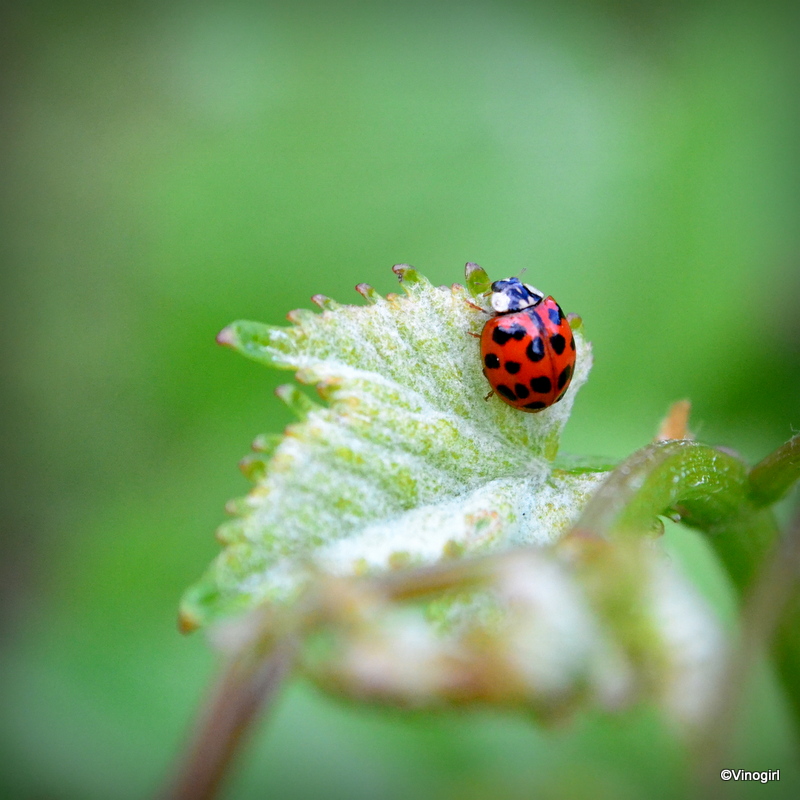
Invasive species are a problem in our ever shrinking world.  And this harlequin ladybird, also known as the Asian ladybeetle (Harmonia axyridis), is invading my personal space by hanging out in the Pinot grigio block.  Identifiable by a distinctive 'M' on their pronotums, harlequin ladybirds seem hell-bent on world domination; I have become very well acquainted with them over the last four years on my trips home to Blighty.
This particular ladybird did not follow me back to California from England.  No, harlequin ladybirds were introduced to the Golden State, back in the 70s and 80s, by the U.S. Department of Agriculture in an attempt to control agricultural pests.  And they have been quite successful in that respect, but they have also been successful in out-competing native North American ladybirds whose numbers are dwindling.  Sad, really.  However, I still like them in the vineyard, they're pretty to look at and I'm assuming that they will be useful in fending off any other invasive aliens.   

Sunday, November 09, 2014

The enemy.

Today is Remembrance Sunday.  This year is a particularly special year as it is the 100th anniversary of the start of World War I.  Since I arrived home on the 29th of October I have been wearing my poppy, (the emblem of the poppies that bloomed across the battlefields of Flanders), with pride. 
I used to love Poppy Day when I was a kid and I couldn't wait to place a small, kid-sized remittance in the familiar red collection box, a donation to benefit ex-servicemen and women.  In return I'd receive my red paper poppy with it's black plastic centre that I wore with enthusiasm.  The Royal British Legion raises a lot of money in their annual poppy appeal which funds their work with the Armed Forces community.  The ladybird in the photograph looks like it is sporting a brilliant red poppy on it's elytra in honour of the war dead.  It looks cute.  But looks can be deceiving.
The harlequin ladybird (Harmonia axyridis), a non-native species, is invading the British Isles.  The harlequin was first spotted here in 2004 and has quickly become one of the most common ladybirds in the country. The invasive harlequin is a rather large species of ladybird and it is a voracious predator, it is able to out-compete the native species for aphids and will also eat other ladybirds' eggs and larvae.  Not good.  The harlequins are clustered in large numbers around window and door frames and in any available nooks and crannies where they hope to overwinter.  Their numbers are quite impressive outdoors and inside: my bedroom and bathroom (at Thud's house) have been invaded also.  They're cute, but like The hun they are persona non grata here.  The world is an increasingly smaller place and invasive species hitchhiking around the globe is increasingly problematic.  I will definitely check my bags when I leave here later this week.
Lest we forget.