Sunday, July 18, 2010

To the highest bidder.

The little something that Vinomaker picked up at the Home Winemakers Classic just so happened to be a 3L bottle of 2006 David Arthur Elevation 1147. Vinomaker was the only bidder for this particular auction lot, not because it is a bad wine, but rather as the result of a slightly bizarre instance of being in the right place at the right time. For a bargain basement price the Elevation 1147 is now settling into it's new home in Vinoland.
I have had this wine on several occasions and have always found it to be very pleasant. I am sure I will enjoy this bottle in the future, especially knowing what a great deal Vinomaker got.

Saturday, July 17, 2010

Home Winemakers Classic 2010.

Vinomaker, my mother and I attended the 28th annual Home Winemakers Classic which was hosted at a new locale this year, an event facility in the town of Yountville.
This annual charity fundraiser attracts a lot of people. I personally found the wine-tasting area at the new venue to be a little awkward to navigate because the flow of the crowd was interrupted by tables at right angles to each other. However, the best thing about the move, from St. Supery Winery to the Groezinger Estate, was that the silent auction wine lots were now indoors... in air-conditioning, a much needed improvement over previous years when temps got so high that the corks in many of the bottles on display had pushed out up to half an inch. Who would want to bid on such potentially spoiled wines?
Vinomaker picked up a little something in the silent auction as he likes to support worthy causes such as the Dry Creek - Lokoya VFD...or maybe it was the swift elbow to his ribs!

Friday, July 16, 2010

La vita è buona.

Thud fed the entire family, including the Vinodogs (who were very happy under-the-table poochies), this evening...and considering we all stuffed ourselves silly, we barely made an impression on the massive pan of baked ziti with meatballs. Washed down with a full-bodied Fruili vino, a splendid time was had by all.
Leftovers for lunch tomorrow? Of course.
Life is good!

Monday, July 12, 2010

Teak a look at this.

Whilst out shopping with my mother, I came across this forlorn looking 375 ml bottle of 1975 Chateau Musar in a patio furniture emporium. Having only my phone with me, I took a quick snap of this once proud, now crestfallen wine relegated to being a mere prop on a circular teak table, but not before I caught the attention of the shop owner. I then endured a 5 minute long dissertation on the merits of a another table (that I feigned interest in) and it's 6" by 2" teak plank top. Not about to fork out $2500 for the aforementioned table, I finally summoned up the courage to inquire as to the provenance of the dejected looking baby-bottle of wine. It was indeed a genuine bottle of Chateau Musar purchased from Sotheby's in New York by a wine-loving friend of the table-touter.
Having shared many wonderful bottles of Musar in the past with my brother and Lord Roby, I left the store feeling rather glum - I do tend to be overly anthropomorphic. What a sad fate to befall this diminutive bottle of wine which once had the potential of being set upon a tabletop as the star of the show, only to be demoted to a supporting role. Wine is meant to be enjoyed...not displayed.

Sunday, July 11, 2010

Y Viva Espana!

Vinogirl was rooting for Spain. Thud was cheering on Holland. Somebody had to win.
The Rioja was pretty tasty.  The Heineken mini-keg remains unopened!

Friday, July 09, 2010

Plump it up!

Fruit set in Vinoland's Pinot gris block seems to have been very successful in 2010: the fruit looks fabulous.
The vines are nearing a transitional period right now - moving away from the stage when vegetal growth dominates to the stage that favours the enlargement and maturation of the fruit. I never get bored with observing the entire process.
Vinomaker is out in the vineyard applying the final sulphur application for this year (for which he is very grateful.) He went to a meeting last night about the European Grapevine moth, so I need to debrief him as to the latest on this bothersome pest...it's a war out there people!

Sunday, July 04, 2010

Happy 4th!

Happy 4th of July to all!
Enjoy fun, sunshine, friends, family, fireworks, good food, and wine - in no particular order (just copious amounts of each.)
Oh...and God save the Queen!

Friday, July 02, 2010

Shattered.

People unfamiliar with the San Francisco Bay Area's micro-climates find it hard to believe that there is a wide range of diurnal temperatures in the Napa Valley also. A friend, who grows Cabernet sauvignon (Clone 7) up in St. Helena, sent me this photograph last weekend of what he originally thought was a grapevine disease. It turns out that his vineyard, that on any given day can be 5-10 degrees warmer than Vinoland, had just experienced a major hiccup in the transition from flower to berry known as shatter.
Fruit set is the stage of berry development 1 to 3 weeks after bloom when most flowers have fallen and those that remain, about 30-60%, develop into berries. Shatter is the detachment of berries from the cluster at the pedicel base (the dark, necrotic tissue in photograph), after the fruit set stage. It appears that the poor fruit set, in this particular vineyard, was the result of dry conditions and high temperatures at bloom. However, shatter can also be exacerbated by variety (Merlot is particularly susceptible), vine vigour, and disease.
What does all this mean? Well, shatter causes widespread yield losses, which in this instance means a diminished crop from which to make wine at harvest time. The fruit set in Vinoland looks solid so Vinomaker will not be without plenty of grape juice to vinify. But he is mourning the loss of those Clone 7 grapes that fell victim to shatter, especially since the 2009 crop surrendered up the best Cabernet of the vintage.

Sunday, June 27, 2010

Ladybirds welcome.

Vinoland is teeming with ladybirds right now. They can be found out in the vineyard in each of their four stages of development; from eggs, to larvae, to pupal stage (shown above), finally emerging as cheerfully enrobed adults. Hippodamia convergens, commonly known as the convergent lady beetle, is the native ladybird species in this part of northern California. I am very happy to see them in such abundant numbers, it means that our vineyard is a healthy and thriving mini eco-system. The fauna living on the vineyard floor, and up in the canopy, are numerous and diversified.
Some alarmist folks warn of the possible problem of ladybird taint, (certain unpleasant volatile compounds that impair the taste or bouquet of a finished wine), if there are a sufficient number of the insects on winegrapes when they are being processed. In more than a decade of witnessing ton after ton of grapes being processed I can't say I am overly concerned with what would be an extremely rare phenomenon. Lots of spiders and earwigs, that unfortunately do not live to tell their tale, but no ladybirds.

Thursday, June 24, 2010

A Cult Figure.

Today, Vinomaker and I had the rare treat of...going wine tasting. Yes, I know we live and work in Napa but going wine tasting can often seem a bit like taking a busman's holiday. However on this fine Napa afternoon, Mr & Mrs Doctor (neighbours of ours who were the winning bidders on a luxury auction lot benefitting the Napa Valley Youth Symphony) had invited us to tag along as their guests on a private tour and tasting at Harlan Estates.
Curled into the western hills overlooking the expansive valley floor portion of the Oakville AVA, this serenely situated property has been, since 1984, the very singular passion of real estate developer Bill Harlan. With just 30 acres of this 240 acre hillside estate planted to grapes, (along with a berry-sorting regimen that borders on the obsessive), only 1500 cases of Harlan are produced each vintage.
On arrival, we were greeted by a charming young lady, given a festive glass of Krug bubbly, and led past a gently flowing water feature to a superbly well appointed eyrie-like patio. From this vantage point the panoramic patchwork of vineyards stretching away below us was truly breathtaking. The entire Harlan property is astounding. It is a pity more people don't get to experience it as unfortunately Harlan is not open to the public.
The last Harlan I tasted was their 2002 vintage; a mere 3 years old, (when I tasted it blind against other '02s from producers such as Phelps, David Arthur, Opus, and Groth), I remember it being quite harsh, disjointed, and most notably, unapproachable. Today, the 2004 poured for us at the conclusion of our tour of the facility was inviting and quite delicious. It showed a little heat, but the mid palate was nicely balanced. There was this huge smoky-bacon thing going on which to me was coquettishly moreish. As the wine warmed in my hands the bouquet of overly ripe blackberries, reminiscent of a hot bramble patch in full July sunshine, filled the rather voluminous Riedel stemware. The finish was a bit odd, not exactly flat but quite abrupt in it's sprint across my taste buds. I can only attribute this one hiccup, in an otherwise eminently desirable glass of wine, to the fact that the Harlan 2004 is still very young and not yet showing anywhere near it's full potential.
Personally I would have liked a little more viticultural insight on the tour, but I do understand that not everyone is a vine geek like me. I contented myself with hanging, most unladylike I might add, over a stone wall to get up close and personal with some gnarly, single cordon trained Cabernet vines that clearly demonstrated the fact that low yields are harvested from the estate's vineyards.
All in all, it was a thoroughly enjoyable experience.

Wednesday, June 23, 2010

The Rhone in Paso Robles?

Yours truly, just spent a very congenial evening with Vinomaker, Sky King, and a bottle of Tablas Creek 2008 Roussanne, (of course that wasn't the only wine we drank.) A delightful Californian interpretation of a Rhone Valley grape variety, this Roussanne was big and lush having undergone malolactic fermentation and six months of sur lie aging. Although I found it ever so slightly flabby, the honeysuckle and beeswax combination, on the nose, was most gratifying.

Friday, June 18, 2010

True Wine Lover 9.

More often than not when meeting people for the first time, in a wine context, folks act a little surprised when I open my mouth and a still rather strong Liverpool accent spews forth (although most Americans wouldn't recognise it as such.) Their doubting looks often betray the fact that they are somewhat sceptical as to how on earth an Englishwoman could possibly know anything about wine. Why not, when everyone else you meet in the course of an average Napa Valley day is a self-proclaimed wine expert? I sometimes wonder, would my viticulture/oenology knowledge carry more weight if I delivered it with a French, Italian or, God forbid, German accent?
Considered by many (but not by me) to be the father of Napa Valley wine, Charles Krug is oftentimes credited with the notable distinction, in Napa wine-lore, of making the first commercial wine (and building the first commercial winery.) This is simply not true: the real star of the birth of the Napa Valley wine industry was, fee-fi-fo-fum...an Englishman!
Born in Lincolnshire in 1797, after much traveling around the United States John M. Patchett was 53 years old when he arrived in Napa in 1850. He proceeded to purchase a 100 acre parcel that became known as 'Patchett's Addition' and planted a vineyard of Mission grapes - the grape variety first brought to California by Franciscan monks. In 1857, Patchett harvested and crushed enough grapes to produce 6 barrels of wine which he then sold for $2 per gallon, thus becoming the first commercial winemaker ever in the Napa Valley. Then in 1859, he solidified his position into Napa wine-history by building the first commercial winery in the Valley, a 33' x 50' stone structure located in what is now downtown Napa. German immigrant Krug began his oenological journey in Napa by making wine at Patchett's winery, eventually founding his own in 1861.
Patchett, a brewer by trade, was by the mid 1860s considered to be the preeminent vintner in the entire Napa Valley. He continued to make wine until 1870, when at age 73 he sold his business and retired. John M. Patchett passed away in 1876 and is buried in Tulocay Cemetery. This is not just some fairytale, it is historical fact. It could only possibly have been made better if Mr. Patchett had hailed from Liverpool....all the best wine experts do, don't they?
Go England!

Thursday, June 17, 2010

Wrong time and place.

Oh dear! This poor baby barn owl has somehow managed to become separated from his/her mother. From sitting on the tyre of our neighbour's truck, the owlet has flapped, fluttered, and hopped into an old wood pile where it may be safe, but for the fact that there is a hawk and a crow shadowing the fledgling's every move. I was sitting here trying to decide whether or not I should attempt to capture it and take it to the local wildlife centre. But then I came across a website that said baby owls quite frequently fall out of their nests and look helpless but are infact well equipped to look after themselves in these situations. So, I have decided to let nature take it's course.
Vinomaker and I for the past several weeks, have been enjoying a glass of wine on the deck every evening at dusk, with the express intent of spotting the pair of barn owls who leave, from the exact same direction each night, on their hunting trips. We have been rewarded with low flybys over the vineyard and even one owl that alighted upon the rollbar of the tractor and glared down the vine rows.
I love barn owls and I hope this particular little guy/gal survives to one day hunt down all of Vinoland's gophers.

Saturday, June 12, 2010

Bursting bubbles.


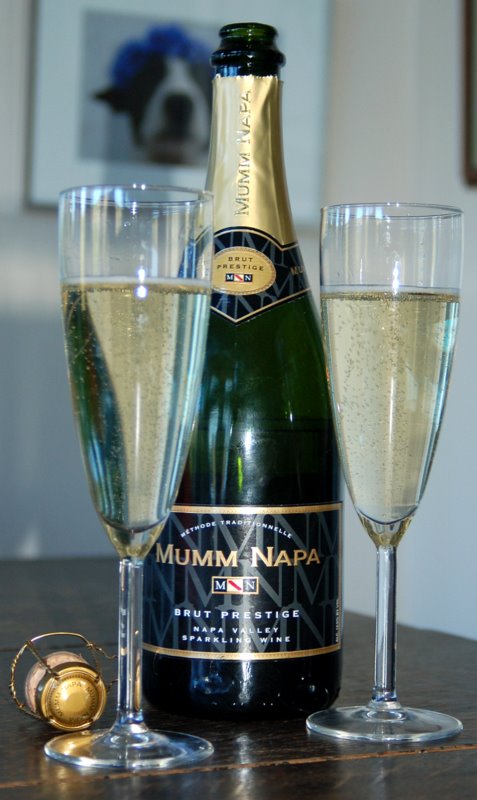
Although technically a draw, Vinomaker agreed that the USA's goal, in their opening World Cup match against England, was indeed the result of a disastrously poor display of goalkeeping. So, as a result of there not being a clear winner we settled on something domestic in the bubbly department by way of a compromise to meet the terms of last night's little wager.
To add insult to injury the wine was corked and ended up being poured down the drain.
I demand a rematch!

Friday, June 11, 2010

Go England!

Hats off to the England Squad, may they triumph in South Africa! They better had (at least over team USA), because I have a wager with Vinomaker for a bottle of something bubbly.

Thursday, June 10, 2010

2009 Agricultural Crop Report.

For anybody who may be interested, the 2009 Napa County Crop Report was recently released and can be read online. The report outlines the varieties and acreage of winegrapes grown in the entire county of Napa, the tonnage harvested, and the dollars that exchanged hands - a whopping $495,000,000 plus. Napa winegrapes are big business, but are still only responsible for about 9% of California's total grape production.
It makes for a great read especially if, like me, you are a grape geek.

Sunday, June 06, 2010

D is for...

...damned lucky!
A propitiously warm Napa evening had me, Vinomaker and the Vinodogs dining outside for what was only the 3rd time this year. A white bean cassoulet, green salad, and garlic bread was just what the doctor ordered after a hot afternoon spent in the vineyard suckering the vines.
We initially paired the cassoulet with a Saddleback Cellars 2008 Pinot blanc, a wine we have enjoyed a lot of lately. Nils Venge, the proprietor of Saddleback Cellars, is perhaps mostly known in these parts for being the first American ever to achieve a perfect 100 point score, given by internationally renowned wine critic Robert Parker Jr. It was OK with the cassoulet. I love this wine just on it's own, but we switched to a Groth 2005 Cabernet sauvignon - the winery at which Mr. Venge was employed when he vinted the 1985 Cabernet sauvignon Reserve that garnered the perfect score.
A French dish paired with French wine varietals on this the most auspicious of days...D-Day; when if it wasn't for our brave British troops, and their stalwart American and Canadian allies, I'd more than likely be sitting here drinking a Gewürztraminer right now!

Friday, June 04, 2010

Vernal bloom.

Finally, the vines are blooming. It's amazing, seeing as there has been no spring here in Napa! The Pinot grigio vines are well on their way, each flower cluster displaying a different stage of bloom. In the photograph you can see that some of the calyptra are brown and are ready to be pushed off by the growing embryo beneath.
The Orange muscat vines are not too far behind, the Syrah is showing about 15% bloom, and even our developmentally challenged Clone 4 Cabernet sauvignon has a flower here and there. Better late than never.
It's going to an interesting vintage, probably a lot like that of 1998.

Thursday, June 03, 2010

Happy St. Morand's Day.

Yes indeedy, this day is dedicated to the patron saint of winegrowers, the one and only St. Morand. Apparently this Benedictine monk was chosen for the job because it is said that he endured one Lent by eating only a bunch of grapes. I wonder which grape variety matures in late winter?
The gorgeous poochy, posing as St. Morand, in the photograph above was the original Vinodog. Unfortunately no longer with us, she was a faithful companion and worked alongside Vinomaker and me as we plotted out the vineyard - mainly digging up gophers, but it's the thought that counts, right? Her happy spirit still lingers in Vinoland, she was a great dog.

Wednesday, June 02, 2010

Just add water.

Whatever your feelings are on cork versus screwcaps (or any other new-fangled wine closure), you cannot deny that cork is undoubtedly the most traditional and widely used of all the stoppers that can actually keep wine in a bottle.
A co-worker (who shall hence forth be known as the Marketing Queen) gave me this Grow-A-Tree kit; a bit of marketing fluff from Cork Supply USA touting the "100% natural, renewable, recyclable, and biodegradable" attributes of Quercus suber. One could hardly call their attempt to champion the CO2-chomping cork oak tree as eco-friendly; the kit contains a plastic growing tube, two plastic wrapped acorns, a plastic bag of growing medium, and a plastic bag of perlite. At least the instruction sheet appears to be printed on recycled paper! Oh...and they ask you to kindly recycle the cardboard tube that the plastic, sorry I mean acorns, came in.
Seeing as I already have a few baby cork oaks growing in Vinoland, I am going to plant these two little acorns and watch them grow into mighty bottle-stopper-producers also...if I live to be 100 that is.