Showing posts with label anthocyanins. Show all posts

Thursday, August 03, 2017

Syrah show-off.

Seven days on, the Syrah grapes are progressing through veraison quite nicely.  A bit more advanced than the rest of the Syrah, this specific vine has always been a bit of an overachiever.
One of the original vines planted in Vinoland (circa 2000), the scion (Durell clone) was grafted onto 110 Richter (berlandieri x rupestris) rootstock.  Arguably the worst rootstock for the soil type in Vinoland, tuff and clay, the 110R-grafted vines eventually failed and the Syrah block had to be replanted.  The replant, though, was to 101-14 Millardet et de Grasset (riparia x rupestris), a much more suitable rootstock. There are approximately eight vines surviving from the first planting, my little poser vine being located in a particularly poor area of soil, I mean shockingly bad. Regardless, the vine seems to have tapped into something it likes below ground and it continues to thrive.  Crazy teenager.

Thursday, July 27, 2017

On the turn.

I suppose I should have checked the Syrah vines before the Pinot grigio (PG) vines, but it just so happens that the PG vines are closest to the house and I pass by them more often.  The Syrah vines, like the PG vines, are indeed going through veraison, forming anthocyanins and dumping said pigment into the grapes. Veraison, to me, is a particularly wondrous physiological change in the vine's life cycle and it never ceases to amaze. Carry on, grapies!

Friday, September 09, 2016

A red leaf day.

I have spent quite a bit of time in the vineyard the past two days.  I am still playing catch up, but I have also started to do some pre-harvest prepping; some leaf removal, a fair amount of canopy management and a little bit of weeding.  There were several, persistent stands of shortpod mustard (Hirschfeldia incana) and spiny sowthistle (Sonchus asper) to be dealt with.  I tripped over a large mat of sharpoint fluvellin (Kickxia elatine) myself, so I think it made sense to remove any large weeds that may get in the way of those who will harvest Vinoland's grapes.
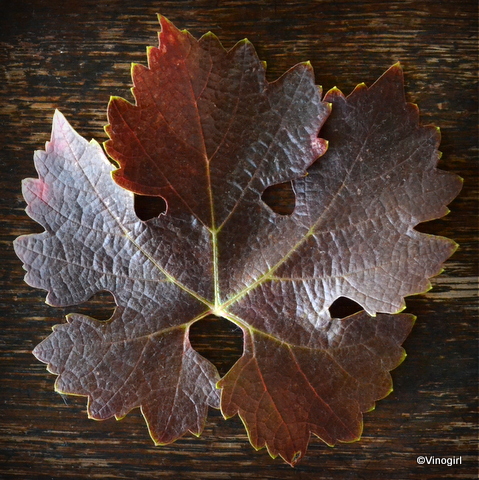
Even though it was a bit toasty out in the vineyard (especially yesterday afternoon) I had an enjoyable time and was even able to stop and have a look at the fruit, the odd insect (including the really odd insect that unexpectedly jumped on me, but which I reflexively flicked away before I could ID it) and the dark red leaf (in the photograph) with the telltale girdling on its petiole.  Darn insects!

Sunday, November 20, 2011

In praise of anthocyanins.

I had to wander around in the Cabernet vines for a while, with the Vinodogs in tow, before I found a red leaf amongst the canopy to photograph.  I actually found three, all obscured by their surrounding yellowing leaves, but this one was the most red.  The reds, oranges, and yellows we see in autumn foliage are due to a group of natural chemical/phenolic compounds called anthocyanins, carotenoids, and xanthophylls respectively.  The red, with which this post is mainly concerned, comes from the pigment found in anthocyanins.
Anthocyanins are valuable to plants giving fruit shades of red, purple and blue (cyan, like one of the ink cartridges we periodically replace in our inkjet printers).  Anthocyanins also provide photoprotection for plants whilst attracting pollinating insects (not necessary for grapevines of course), birds and other grape-munching creatures that can aid in the dispersal of seed.  And, of course, it’s anthocyanins we see in all their glory each autumn as the leaves on deciduous trees change colour before dropping.
The thing with grapevines, though, is that it is the grapes that are supposed to change colour, not the leaves.  Grape clusters begin to change colour with the onset of veraison with red varieties deepening to their characteristic purple.  The grapes are also undergoing other complex changes that are not visible to the eye, but that result in an accumulation of sugars and other desirable compounds prized by winemakers and wine-imbibers alike.

The anthocyanin content in a wine ranges from zero in a variety devoid of skin pigment (e.g. Pinot blanc versus Pinot noir), to a maximum of about 2,500 to 3,000 mg/kg in a teinturier variety, such as Alicante Bouschet. In a good glass of Cabernet sauvignon, like a glass of wine from the vine in the above photograph, one could expect an anthocyanin content of about 890 mg/kg.  I am not a chemist, so I am not going to get into how the pigment in grape juice is influenced by acidity, pH, tannin, flavones, co-pigments, iron and other metals - not to mention a dozen environmental factors.  The main anthocyanin (not to be confused with anthocyanidins, their dietetic counterparts) in most V. vinifera varieties is malvidin-3-monoglucoside.  I know, it's hard for me to pronounce too. But, unless you are a winemaker, the actual knowledge that anthocyanins are anthocyanidins that have been modified by the attachment of a molecule of glucose matters little.  What matters most to the average wine-lover is the beautiful purple-blue hue that one espies in the miniscus of the young wine about to be consumed from one's glass.
So, raise a glass of a little something luxuriously red (a squid ink black Petite sirah, perhaps?) and join me in a toast to the attributes of the not-so-lowly anthocyanin.

Thursday, November 17, 2011

Going viral.

Long before viral became a marketing buzzword to describe how thoughts, information and trends move into and through a human population, the Napa Valley's grapevines were going viral without any help from social media.
The are many viruses that cause diseases in grapevines, and due to the woody nature of much grapevine tissue, it is often difficult to purify such tissue. New vineyards planted from infected cuttings or budwood will be diseased from the time they are established. That is why a programme such as the Foundation Plant Services (FPS) at UC Davis is so vital to the wine industry. FPS is a self-supporting service department in the College of Agricultural & Environmental Sciences and is very instrumental in the detection and elimination (using heat treatment techniques) of grapevine diseases.
Grapevine leafroll is probably the most wide-spread virus disease of grapevines and there are currently 9 different viruses associated with leafroll. Leafroll spreads slowly from vine to vine and impacts both vine health and grape quality, in some instances reducing yields as much as 50 percent or even more, depending on the severity of infection. Typical leaf symptoms include reddening of the leaves between major veins in red varieties. Thus, we can assume that the vivid dark red of the vine in the above photograph, and the reddening of its neighbouring vines on the Silverado Trail, indicates that it is indeed a red variety.
A green leaf is green because of the presence of a pigment known as chlorophyll. When chlorophyll is abundant in the leaf's cells, as they are during the growing season, the chlorophyll's green colour dominates and masks the colours of any other pigments that may be present in the leaf. Consequently, the leaves of summer are characteristically green, but in the autumn and at harvest time the entire vine takes on a reddish cast. It's very pretty, but it's very unhealthy.
When a virus is present it disrupts the normal physiological function of the vine's cells. A healthy vine will efficiently remove pigments leaving the dying leaf to become yellow, then brown, followed by the detachment of the petiole from the shoot and leaf drop. The red pigment in the leaf, anthocyanin, is usually the most difficult pigment to remove when the vine's phloem has been compromised by a virus. Exactly how leafroll affects the anthocyanin pathway through the vine's vascular system remains a mystery and is the subject of ongoing research. Curiously, a way of checking if a particular vine is infected with leafroll virus is to graft a bud from the suspect vine onto a healthy Cabernet franc vine. This vinifera cultivar is very sensitive to the disease, showing strong symptoms sometimes within as little as 18 months of grafting.
Because leafroll virus does not kill vines, but instead causes reductions in yield, maturity and quality, infected vines are rarely removed from otherwise healthy and productive vineyards. The only effective control of leafroll, or any other grape virus disease, is to ensure that healthy propagating material from virus-tested stock is used to plant vineyards.
Red coloured foliage, although the result of disease in a vine, really is very attractive. I, along with the valley's tourists, really enjoy the show.

Thursday, October 15, 2009

My girdle is killing me.

Whilst walking through the vineyard late this afternoon, checking on how the Syrah vines are shutting down for the winter, I noticed a red leaf. I did not panic, instead I checked the leaf's underside.
A ha! As I expected I found insect damage: girdling of the petiole. Now in this neck of the woods there are two main suspects for such crimes against vines; the Buffalo Treehopper (Stictocephala bisonia) and the Three-cornered Alfalfa Hopper (Spissistilus festinus). Damage to the vine occurs when continuous feeding punctures, resulting in the interruption of the movement of materials to the leaf, reduce chlorophyll production and cause anthocyanins to become the dominant pigment remaining in the leaf. The reddish leaves look like those of Leafroll virus, hence my concern upon espying the offending leaf.
It is obviously not a big problem, seeing as this is the only red leaf I have seen in the vineyard, but it was a momentary cause for concern. After all, you need healthy vines to make yummy wines.

Wednesday, September 17, 2008

Size matters?

It does if you are a grape, a wine-grape to be more specific. A small berry has a larger surface area-to-volume ratio, and so more skin to juice. Beyond sugar accumulation other important developments in the berry are the production of compounds such as anthocyanins, tannins and flavanols. Many of these compounds are more abundant in the skin and seeds and when embraced by phenolics they contribute colour, astringency and flavours. The above picture illustrates this ratio difference with the comparison of a table grape (Red globe) to a wine-grape (Syrah -Durrell clone). We do not stress our wine-grapes here, we want them to mature at their own pace. So c'mon boys, be mature about it, admit that size does matter...and in this case, less can be more!