Showing posts with label Vitis vinifera. Show all posts

Saturday, September 26, 2020

My spectacular Syrah.

This morning, starting at the crack of dawn, was harvest-day for Vinoland's Syrah (SY).  And, wow, the fruit looked fabulous and (now that the grapes have been processed) it tastes terrific.  Vital statistics are; 23.6 °Brix, pH 3.63 and TA 4.40 - all in a good range.  To celebrate I opened a bottle of our 2015 SY with dinner - delightful. 
I love farming SY, it is such an easy grapevine to get along with.  Sadly, that's all my SY interaction done with for 2020.  I am going to wait a while before I begin to even think about starting to prune in early 2021.  Besides, I still have to get the Cabernet sauvignon picked.  
Now it's time for Vinomaker to work his magic. 

Sunday, May 17, 2020

Distinction.

In my opinion, the leaf of the Cabernet sauvignon (CS) vine is the most distinct of all Vitis vinifera varieties.  The very deeply, almost always overlapping (appearing as if the leaf is pierced with five holes) lobes on the leaf,  including the lyre-shaped petiolar sinus, make the CS leaf very recognisable.  (This specimen, photographed this morning, is wet because it rained overnight.)  By comparison, the leaf of a Chardonnay vine has extremely shallow sinuses and a petiolar sinus which is u-shaped.  I find ampelography, the field in botany that is concerned with the identification and classification of grapevines, fascinating. 
To my mind, nowadays, it is a distinct pity that wine made from CS grapes is not always recognisable as truly varietal in character (as is the grape variety's leaf).  Reflect upon the descriptors that self proclaimed Cab-lovers use to describe their favourite Cabs; jammy, bold, chewy, fruity, chocolate-y, smoky and, sometimes even, raisin-y (heaven forbid) etc.  What happened to the true characteristics of the varietal?  The finessed, medium-bodied clarets that I cut my wine drinking-teeth on, a wine with herbaceous undertones (pyrazines), tea leaves, damp earth, mint, cherries and violets, seem to be a thing of the past.  Cabernet sauvignon, où êtes-vous?  It's a vinous-conundrum.
Living in the Napa Valley doesn't exactly help my dilemma, either.  Napa is the poster child for big, intense, overblown, super extracted and high alcohol wines that are made to be consumed early.  There isn't a hope that the current style of CS being produced in the valley is chemically capable of aging for 20-30 years.  Perhaps I'm just getting old, my tastes are changing.  I'm okay with that.  That being said, I'm off to have a glass of an Austrian Grüner Veltliner.  Cheers!

Friday, February 08, 2019

Don't start me, fuzzy-buddy.

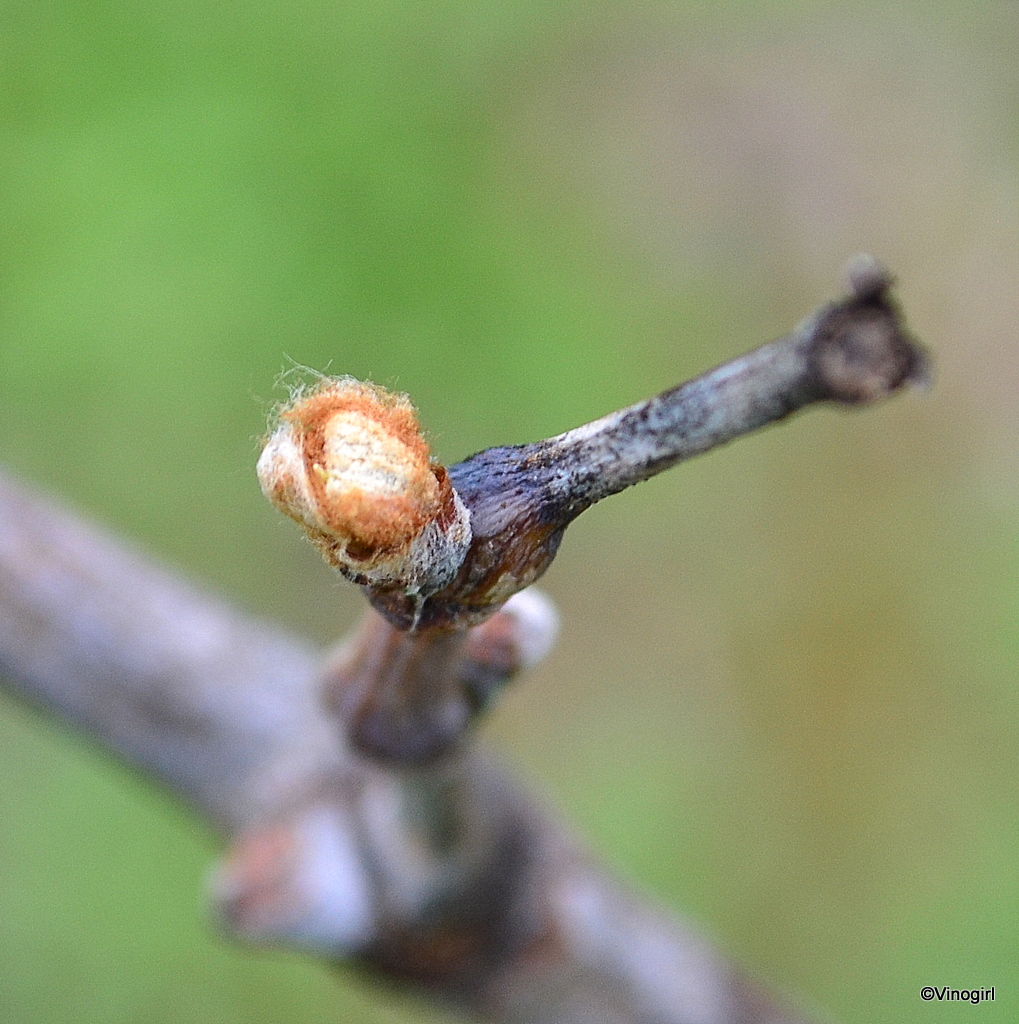
No, stop!  I am not ready for budbreak.  This promiscuous, young Viognier vine, the only Viognier vine in Vinoland, is trying its hardest to get going for the season.  I made it my job to set the little fellow straight, but not before I finished pruning the Pinot grigio vines. 
A good example of apical dominance in Vitis vinifera, albeit a very subtle one, this stunted lateral shoot was having delusions of grandeur.  The whole unit was removed (as is all the lateral growth of this nature), but not before the prospect of an early start to the growing season gave me, well, a little start.

Thursday, May 31, 2018

Vintage snapshot.

As I had mentioned in an earlier post, flowering is a little retarded this year.  The Orange muscat (OM) vines are usually (in an average year) further through bloom at this stage of the growing season.  And please, do not be alarmed, the OM flower cluster in the photograph is not upside down: it is a mildly curious fact that the OM clusters point upwards until the baby grapes advance to a stage when they cannot defy gravity any longer.
I had had a tiny internal debate, with my slightly schizophrenic self, about whether or not to post a photograph of Vinoland's OM bloom this year.  I mean, one Vitis vinifera flower looks much like another, doesn't it?  But then it occurred to me that even though, at this point, it is impossible to tell what the finished wine from this vintage will be like the vintage is in the flower cluster right at the moment the photograph is taken, so each vintage's image is unique.  The flowers that I photograph are different every year, one cannot see the vintage, but it is there.

Tuesday, May 23, 2017

Bloom is bustin' out all over.

Everything is blooming in Vinoland, except for the Cabernet Sauvignon. But that is not surprising, as the Cabernet Sauvignon is always the last variety to go through bud break and bloom.
The wonderful weather we have been having in the Napa Valley of late is absolutely ideal for bloom. Vitis vinifera generally likes the temperature to be about 85°F during bloom and will quite happily bloom away in the heat - until temperatures reach above 95°F when, like me, the vines get a little toasty.  Temperatures above 95°F can result in bloom, and fruit set, being adversely affected.  The grapevines and I are so sensitive.

Wednesday, August 03, 2016

Dr. Frank.

The next book, in my personal quest to understand more about the history of Vitis vinifera in the United States, is this book by Tom Russ: Finger Lakes Wine and the Legacy of Dr. Konstantin Frank.
Dr. Frank was by all accounts a bit of a poop disturber; in that he tried to shake up the New York state wine industry by repeatedly insisting that V. vinifera, i.e., European winegrape varieties, could thrive in the eastern United States.  It is in Dr. Frank's expertise as a viticulturalist, and his scientific approach to clonal selections, that I am mostly interested in.
Love wine-history.

Thursday, May 05, 2016

Each to their clone.

Lately, (if almost two years to the day can be considered lately), I have become very interested in the different characteristics that can be attributed to specific clonal selections of Vitis vinifera.  But what exactly is a clone?
Hortus Third offers this definition of a clone: "A plant propagated by asexual or vegetative means, including divisions, buds, cuttings, layers etc...Clone is a horticultural rather than a taxonomic term."
In regards to the grape/wine industry, a clone is a variant of a grape variety that is unique in some detectable way, whether by changes in the way a grapevine expresses a particular gene, or minor mutations in the grape variety.  Each clone, in this case let's say a clone of Cabernet sauvignon (CS), will taste like the parent variety, but with slightly varying characteristics, e.g., higher acidity, more concentrated fruit, firmer tannins.  Nowadays, it is common practice for growers, and winemakers, to utilise a variety of different clones, much like a cook will select different herbs and spices, to achieve certain flavour profiles in a finished wine.
The fact that I am interested in geeky viticultural goings-on would not come as a surprise to anyone who knows me.  But something that surprised me was the scarcity of information available about this particular subject matter.  I discovered this (yes, almost two years ago), when I attempted to do some research prior to purchasing some grafted grapevines to fill in the spaces where several vines had died in Vinoland's CS block.
There is a lot of anecdotal information to be had by talking to folks who are interested in viticulture, but a lot of it is useless.  Just recently, an acquaintance of Vinomaker mentioned to him that he thought CS clone 169 was a great clone to grow in the Tundra (aka Vinoland, Coombsville AVA).  I happen to be familiar with this clone, as Vinomaker used to make wine for a couple we know who used to grow this particular clone.  Clone 169 did indeed ripen in a timely fashion in Coombsville.  It is a pity we have clone 4 (a veritable retard, in the nicest possible sense of the word) planted here in Vinoland, (and oh, how I wish we didn't).  But it is what it is.  The little bit of information on clones that is available in written form comes from research conducted by John Caldwell and Anthony Bell of Bell Wine Cellars.  (Hmmm, perhaps someone should seriously consider compiling a reference work.) I eventually settled on clone 337 for my replants.
As for the wine in the photograph, this CS claiming to be made solely from clone 337 was an unremarkable, quotidian quaff.  To be fair, I did not do a comparison tasting of this wine with another made from a different clone.  However, I have comparison-tasted in the past; I have tasted clone 4 (Vinoland), clone 7 (St. Helena Sots) and clone 169 (North Avenue Negociants) side by side and they were quite distinct from one another.
Interesting stuff, I need to know more.

Saturday, September 24, 2011

Bye bye leaves.

The leaves of Vitis vinifera live for approximately 150 days: that's almost a full 5 months, from the time of budbreak, of basking in the warm California sun. The basal leaves, the first to appear in the spring, have done their very best for this vintage and are now amongst the first to slowly take their leave. See ya next year!

Friday, May 08, 2009

One small step.

Went out shopping with the family today, we decided to go to a nursery. The weather was OK, no rain but lots of wind.
Of course I had to go and take a peek at the vines that were being offered for sale. All the vines were Vitis but no recognisable wine varieties. Thud decided to purchase a Regent grapevine, a dark skinned variety that apparently can be used for wine production, or as table grapes. He's not going to get much wine out of one plant, but it's a start. Thud makes great cider though, so perhaps he should leave the winemaking to Vinomaker.

Friday, April 17, 2009

Last but not least.

Today, I noticed budbreak in our Cabernet sauvignon. We probably will still have a couple of incidences of frosty mornings but this fortuitous late budbreak in Cabernet is one of the reasons it is so successful in this part of the world.
The King of Vitis still reigns supreme.